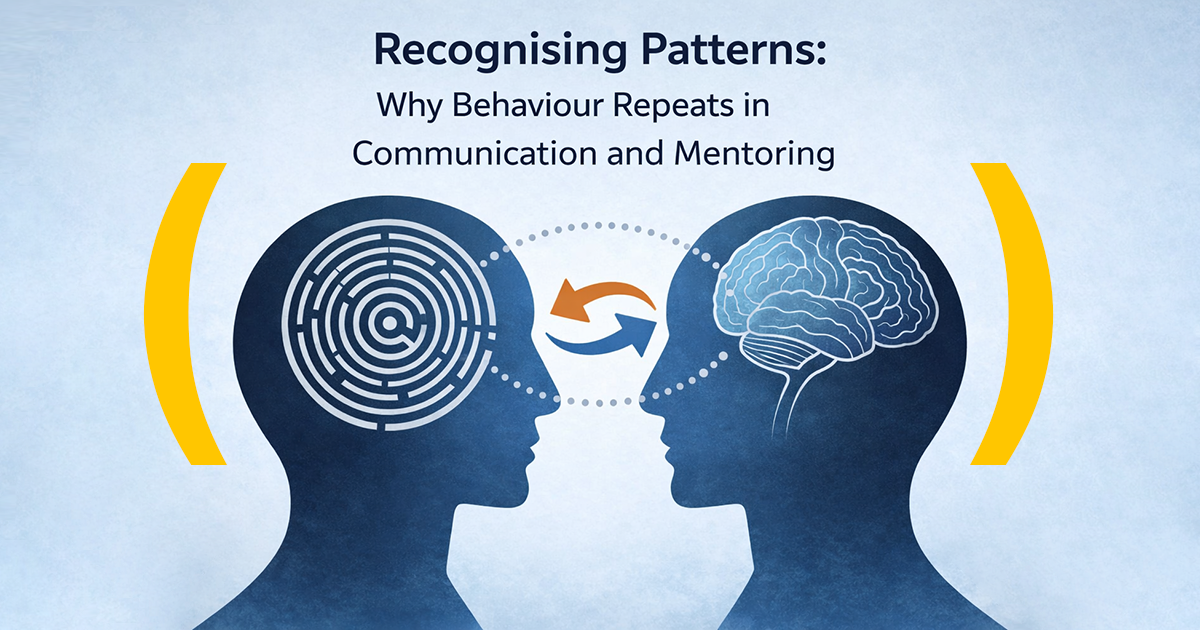
Recognising Patterns: Why Behaviour Repeats in Communication and Mentoring

Recognising behavioural patterns in mentoring and communication through ego states and self-awareness

From Internal States to Observable Behaviour in Mentoring Practice

Behaviour in mentoring contexts rarely emerges as an isolated or spontaneous act. Rather, it reflects structured patterns that have developed over time and continue to operate with a degree of consistency, often outside conscious awareness. What appears on the surface as hesitation, resistance, or repetition is typically the manifestation of underlying cognitive and emotional processes that have become embedded through prior experience.

To understand behaviour within mentoring relationships, it is therefore necessary to move beyond surface-level observation and attend to the internal conditions that give rise to it. Without this shift in perspective, the mentor risks responding to symptoms rather than engaging with the underlying structure that sustains them.

The Continuity of Behavioural Patterns

Repetition in behaviour does not occur due to a lack of capability or insight. On the contrary, individuals frequently recognise that their responses may be ineffective, yet they continue to enact them. This apparent contradiction can be understood through the concept of behavioural continuity, whereby familiar responses provide a sense of psychological stability, even when they no longer serve a constructive function.

Over time, such responses become automatised. They are enacted with minimal deliberation and are often triggered before reflective processes have an opportunity to intervene. Within mentoring conversations, this continuity becomes visible through recurring narratives, consistent forms of justification, or repeated patterns of engagement and withdrawal.

What is important here is not the specific content of what is expressed, but the structure of repetition itself. The persistence of a pattern signals that it is being maintained by an underlying logic that remains intact.

Triggers and the Activation of Internal States

Behavioural patterns do not operate in a constant or uniform manner; rather, they are activated in response to specific stimuli. These triggers may be overt or subtle, ranging from direct challenges to shifts in tone, ambiguity, or perceived expectations within the interaction.

Once activated, an internal state begins to organise perception and response. The individual does not simply choose a reaction in that moment; instead, the reaction unfolds from a pre-existing configuration of meaning, shaped by prior experience and reinforced over time.

For instance, a question that introduces accountability may activate a defensive orientation, while uncertainty may elicit avoidance or deferral. The observable behaviour is therefore not arbitrary, but the outcome of a patterned internal response to a perceived condition.

This process explains why conversations can change direction abruptly. The external topic may remain consistent, yet the internal positioning of the individual shifts, producing a corresponding change in behaviour.

Communication as an Expression of Pattern

Patterns become most accessible through communication. Language, tone, pacing, and interactional dynamics provide a rich source of data through which underlying structures can be inferred.

A coachee may respond to a challenge by interrupting or redirecting the conversation, thereby maintaining control. Another may adopt a compliant stance, offering agreement without substantive engagement. In some cases, individuals extend their explanations beyond necessity, using elaboration as a means of stabilising their position.

Such behaviour is not accidental. They represent coherent expressions of internal organization that are repeated across contexts and interactions.

The task for the mentor is not merely to interpret what is being said but to attend to how it is being communicated. This shift from content to structure allows for a more precise understanding of the dynamics at play.

The Role of Self-Talk in Maintaining Patterns

Behavioural repetition is sustained not only through external interaction, but also through internal dialogue. Individuals construct and reinforce their responses through ongoing self-talk, which shapes both perception and justification.

These internal narratives often operate implicitly. They may take the form of assumptions about what is required, beliefs about capability, or expectations regarding the consequences of action.

For example, an individual may hold an unexamined belief that conflict must be avoided to preserve relationships or that certainty must be maintained to sustain credibility. These beliefs, while rarely articulated directly, exert a significant influence on behaviour.

In mentoring contexts, bringing such narratives into awareness can be transformative. It enables the coachee to recognise the connection between belief and action, thereby creating the conditions for reconsideration and change.

Interrupting the Pattern

Change does not occur through instruction alone, nor through the imposition of alternative behaviours. It begins with the recognition of the pattern itself.

The mentor’s intervention, therefore, is most effective when it draws attention to what is recurring, rather than prescribing what should replace it. This requires a disciplined form of observation, combined with the capacity to introduce reflection without judgement.

A well-placed question can serve as a point of interruption, creating a moment in which the coachee becomes aware of their process. At that moment, the automatic sequence is disrupted, and the possibility of choice emerges.

It is this transition, from automaticity to awareness, that marks the beginning of meaningful change.

The Mentor’s Position

The effectiveness of this process depends significantly on the position adopted by the mentor. A directive stance may reinforce existing patterns, particularly if it mirrors the dynamics already present in the coachee’s behaviour.

By contrast, a reflective stance allows the mentor to engage with the structure of the interaction rather than its immediate content. This does not imply passivity, but rather a deliberate form of engagement that prioritises awareness over resolution.

In practice, this may involve tolerating ambiguity, resisting the impulse to provide immediate solutions, and maintaining attention on the process unfolding within the conversation.

Such an approach requires discipline, but it enables a deeper level of engagement with the mechanisms that sustain behaviour.

Integration Within the BE(YOU)FULL Framework

Within the BE(YOU)FULL framework, the recognition of behavioural patterns constitutes a critical stage in the development of awareness and agency. The framework does not treat behaviour as an isolated phenomenon but situates it within a broader system of internal states, beliefs, and contextual influences.

This integrative perspective allows for a more complex understanding of how individuals operate and provides a structured basis for intervention. By linking observable behaviour to underlying processes, the framework supports a shift from reactive engagement to intentional practice.

In applied settings, this translates into more coherent communication, greater consistency in decision-making, and an increased capacity to navigate relational complexity.

Conclusion

Behaviour persists because it is structured, not incidental. Its repetition reflects an internal coherence that, while often implicit, remains active across contexts.

Mentoring that engages only with surface behaviour is limited in its capacity to effect change. By contrast, mentoring that attends to the patterns underlying behaviour creates the conditions for a more fundamental shift.

The recognition of these patterns does not in itself resolve them. But it alters the terms of engagement. It introduces awareness where there was automaticity and, in doing so, opens the possibility of a different response.

Carlos Simpson is an entrepreneur, strategic graphic designer, artist, musician, and author based in London, United Kingdom. He graduated from the University of the West of England with a degree in Graphic Design and completed a placement at Neville Brody's Research Studios in London. Since then, he has worked as a designer for several well-known brands, including Topman, Selfridges, Ted Baker, Ben Sherman, and Oxfam. In 2016, he founded Carlos Simpson Design Studio in London. Carlos's paintings have been purchased by notable businesspeople, including Sergio Marchionne. As an author, Carlos is inspired by exploring new environments and cultures and finding ways to engage with his surroundings through authentic situations and conversations. He follows a ritual of improvising to better understand the human brain and the effect it has on individual lives, with the intention of exploring feelings, relationships, and daily situations and the magic touch of empathy. This is his key to being creative and productive. His writing aims to amuse, persuade, and inform readers, and he hopes to inspire them through his work. His notable publications include "Politics Design: The Power of Political Stamps," "Sketchbook: A Survival Guide," "You Make Your Rights," "Signs of Fingerprints," "Portraits of the Self," and "Fingerprints," which was his 2020 Lockdown Project.

Leave A Reply

Your email address will not be published. Required fields are marked *