
BE(YOU)FULL CIC · Human Development
From “Be You” to Belonging: Why Identity, Recognition and Participation Matter in Human Development
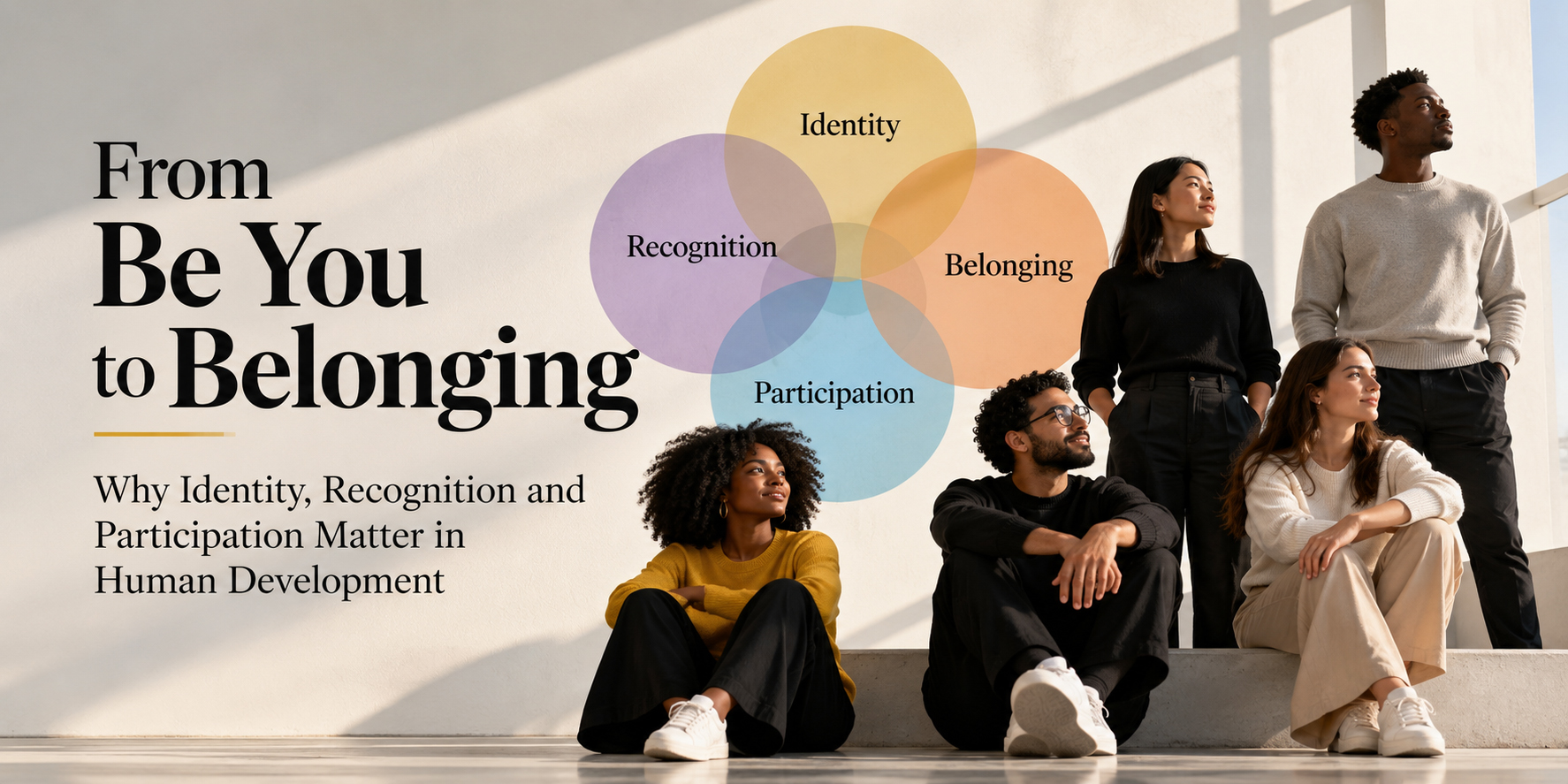
Identity is not only about knowing who you are. It is also about how you are recognised, whether you experience belonging, and whether you are able to participate meaningfully without having to conform.
Identity matters. But identity alone is not enough.
A person may know something about who they are and still find themselves in an environment where that identity is misunderstood, constrained or ignored. They may be physically present in a school, workplace or community without experiencing recognition. They may be invited to participate without having meaningful influence. They may be told that they belong while feeling pressure to adapt themselves in order to be accepted.
This distinction matters.
Human development does not take place through the individual alone. It develops through the relationship between the self, others and the world: how we understand ourselves, how we encounter and are recognised by other people, and how we participate within the social, cultural and institutional environments around us.
Within the BE(YOU)FULL philosophy, these relationships are interconnected. Identity affects participation. Recognition affects agency. Belonging affects whether people feel able to contribute. And the environments in which people live, learn and work influence what they believe is possible.
This is why the growing institutional interest in identity, inclusion and belonging deserves closer attention.
Identity is not simply a personal matter
Identity is often described as something located within the individual: a collection of characteristics, experiences, values, affiliations and beliefs that answer the question, “Who am I?”
That is only part of the picture.
Identity is also relational.
We develop our understanding of ourselves through experience, interpretation and interaction. Other people respond to us. Institutions classify us. Communities include or exclude us. Cultural narratives provide categories through which we may understand ourselves and others.
Identity therefore develops in continuing interaction between an inner sense of self and an external social world.
The OECD has described understanding who we are and where we belong as a fundamental aspect of human development. Its work on identity and belonging also identifies relationships between positive identity, agency, learning and wellbeing.
This has consequences for education, organisations and society.
It means that supporting human development requires more than encouraging individuals to become confident or self-aware. We also need to examine the conditions within which people are expected to develop.
An environment can strengthen agency.
It can also restrict it.
Recognition connects identity to the social world
Knowing who you are does not automatically mean that other people will recognise your identity, experience or contribution.
Recognition introduces another dimension.
To recognise a person is not simply to notice their presence. It involves acknowledging their personhood, perspective, capability and contribution.
This becomes particularly important in institutional life.
Employees may technically have access to the same organisation while experiencing very different levels of recognition.
Students may occupy the same classroom without experiencing the same degree of acceptance or participation.
Members of a community may be formally included while remaining peripheral to the decisions that affect them.
Recognition therefore helps connect identity with belonging.
This is not necessarily a linear sequence. Each element can influence the others.
Participation can strengthen belonging.
Contribution can generate recognition.
Recognition can strengthen a person's confidence to exercise agency.
Conversely, repeated misrecognition or exclusion can affect how individuals understand themselves and their relationship with the institutions around them.
Human development is therefore both personal and relational.
Belonging is not conformity
This distinction is essential.
Belonging should not require people to erase the characteristics that make them different.
A person does not meaningfully belong simply because they have learned how to behave in ways that minimise disagreement, difference or individuality.
That is closer to conformity.
Meaningful belonging allows people to remain recognisably themselves while participating constructively within relationships and communities.
Current CIPD guidance makes a similar distinction in the workplace, describing inclusive organisations as environments in which people can belong without having to conform or mask their identities.
The distinction has practical consequences.
An organisation may recruit people from different backgrounds while rewarding only one dominant way of thinking.
A school may describe itself as inclusive while students learn that certain experiences are better left unspoken.
A team may invite different perspectives while repeatedly allowing only established voices to shape decisions.
Representation is not the same as belonging.
And belonging is not the same as passive acceptance.
Healthy belonging creates conditions in which individuality and relationship can coexist.
BE(YOU)FULL Framework
Self, others and the world
The BE(YOU)FULL Three Interconnected Relationships Framework approaches human development through three inseparable relationships.
Self
How do I understand myself? What experiences, interpretations, values and decisions shape my identity? How aware am I of the forces influencing the person I am becoming?
Others
How do I recognise other people? How am I recognised by them? What happens through dialogue, difference, care, conflict, collaboration and responsibility?
World
How do I participate within institutions, communities and wider society? What conditions shape my opportunities? What responsibilities accompany my participation? What am I contributing?
These relationships continually affect one another.
The self does not develop outside society.
Relationships do not exist outside wider social and institutional conditions.
And institutions are ultimately created, maintained and changed through human participation.
Belonging therefore occupies an important position within the framework.
It links the experience of the individual to the communities and structures within which that individual participates.
From belonging to agency
Belonging becomes especially important when considered alongside agency.
Agency concerns a person's capacity to make choices and act in relation to those choices.
But agency is never exercised in a vacuum.
People act within families, schools, workplaces, communities, cultures, economic conditions and institutional systems. These contexts can expand or constrain the range of actions available to them.
A meaningful sense of belonging can create conditions in which people feel able to speak, question, initiate and participate.
The opposite can also occur.
Where belonging appears conditional, individuals may devote substantial attention to interpreting what behaviour will keep them accepted.
What do I think?
What am I expected to think?
What contribution can I make?
What contribution is safe for me to make?
This difference has implications for creativity, leadership, learning and organisational life.
Agency requires more than permission.
It requires an environment in which exercising judgement does not automatically threaten belonging.
Judgement gives agency direction
Agency without judgement can become reaction.
BE(YOU)FULL therefore treats judgement as an important human-development capacity.
People constantly interpret situations, weigh alternatives, consider consequences and decide how to respond.
This is particularly significant in environments characterised by rapid technological, organisational and social change.
Belonging should not remove disagreement.
Nor should it require consensus.
A mature community creates enough relational security for people to exercise judgement, question assumptions and encounter difference without immediately interpreting disagreement as rejection.
This is one of the reasons belonging and conformity need to remain conceptually separate.
A conforming environment may appear harmonious precisely because people have learned not to challenge it.
A genuinely participatory environment can contain disagreement because people remain recognised as legitimate participants even when their perspectives differ.
Responsibility accompanies participation
Belonging cannot be reduced to what an institution provides for an individual.
There is also a reciprocal dimension.
To belong is to participate in relationships that carry responsibilities.
People affect other people.
Decisions have consequences.
Participation changes environments.
Human development therefore involves becoming increasingly able to recognise both personal agency and relational responsibility.
Questions of responsibility
- What effect does my behaviour have on others?
- What responsibilities accompany my position?
- Whose perspectives are absent?
- What happens when my freedom conflicts with another person's needs?
- How should I respond when an institutional norm causes exclusion?
Belonging becomes more substantial when people are able not only to receive recognition from a community but also to contribute responsibly to that community.
Participation is where belonging becomes visible
Institutions frequently describe belonging through statements of culture or values.
The more difficult question is whether belonging can be experienced through participation.
Who speaks?
Who is heard?
Who makes decisions?
Whose contribution receives recognition?
Who progresses?
Who remains peripheral?
Who feels able to disagree?
Who changes themselves in order to remain accepted?
These questions move belonging from aspiration to practice.
Research on workplace inclusion increasingly identifies similar dimensions. Inclusion has been associated with being accepted, having one's identity respected, participating in decision-making, receiving recognition and being integrated into workplace relationships rather than merely occupying a formal role.
This is important because belonging is not simply a feeling to be engineered.
It emerges partly from how institutions distribute recognition, opportunity and participation.
Why organisations are talking increasingly about belonging
The language used by major institutions is changing.
Traditional corporate communication often concentrated on employment, performance and career progression. Contemporary organisations increasingly communicate around ideas such as individuality, wellbeing, inclusion, authenticity, community and belonging.
This reflects wider changes in organisational thinking.
The CIPD connects equality, diversity and inclusion with recruitment, retention, organisational culture, belonging and people's capacity to contribute fully.
The shift is also visible in education.
OECD research describes identity and belonging as significant to learners' wellbeing, participation and development. Its education research has repeatedly connected students' sense of belonging with social connection, engagement and educational experience.
These developments suggest a broader institutional recognition: people cannot always be understood adequately as employees, students, consumers or service users alone.
They are persons participating within systems.
Institutional example
A current institutional example: Barclays
Barclays provides one contemporary example of this shift in organisational language.
Its careers material currently uses the proposition “Be you. Be valued. Belong.” and presents inclusion, recognition, community and opportunity as aspects of employee experience.
Elsewhere, Barclays describes its ambition to create a workplace where people feel supported, included, recognised and involved.
This example does not establish that Barclays is applying the BE(YOU)FULL Framework, nor does similarity in broad themes establish derivation.
Concepts such as individuality, inclusion, recognition and belonging now form part of a wider international conversation across organisational development, education, psychology and human resources.
What is significant is the institutional direction.
A major organisation is using language that treats being oneself, being valued and belonging as connected elements of participation in organisational life.
This is useful evidence of a wider movement.
The strategic question for human development is what comes after the language.
Beyond inclusion language
Saying that people should “be themselves” does not explain how identity develops.
Promising belonging does not explain the relationship between belonging and agency.
Recognition alone does not explain judgement.
Inclusion alone does not explain responsibility.
Participation alone does not establish whether that participation is meaningful.
These questions require a wider architecture of human development.
Belonging interacts with every one of these areas.
It is therefore not treated as an isolated organisational initiative.
It is part of the conditions through which people become participants in their own development and in the development of the communities around them.
From presence to meaningful participation
A useful distinction can therefore be made between four different states.
Presence
I am here.
Inclusion
I am permitted to participate.
Belonging
I experience myself as a legitimate member of this environment without having to abandon who I am.
Meaningful participation
I can exercise agency, judgement and responsibility, and my contribution can affect the shared environment.
These distinctions matter because institutions can achieve one without necessarily achieving the others.
A person can be present without being included.
Included without feeling that they belong.
And feel a degree of belonging without having meaningful influence.
Human-centred development therefore asks institutions to look beyond the first question — Who is present? — towards more demanding questions.
Who is recognised?
Who belongs?
Who can exercise agency?
Who participates in decisions?
Who is able to contribute?
Belonging as a developmental relationship
Belonging is sometimes discussed as though it were a destination: once the right culture exists, people will belong.
Human experience is more dynamic.
Identity changes.
Relationships change.
Institutions change.
Communities change.
The experience of belonging must therefore be continually negotiated through interaction between the individual and the environment.
This returns us to the relationship between self, others and the world.
Human development takes place across all three.
That is why belonging matters.
Not because everyone should become the same.
Not because difference should disappear.
And not because organisations need another language for employee engagement.
Belonging matters because people develop through relationships while remaining distinct persons.
The challenge for contemporary institutions is therefore larger than helping people fit in. It is to create the conditions in which people can understand themselves, recognise others, exercise judgement, participate responsibly and contribute meaningfully to the environments they share.
That is the movement from simply being present to being, relating and participating fully.
BE(YOU)FULL CIC
Frequently asked questions
What is the relationship between identity, recognition and belonging?
Identity concerns how a person understands who they are. Recognition concerns how that person is acknowledged by others and by the institutions around them. Belonging develops when people experience themselves as legitimate participants in a community or environment without having to abandon important aspects of who they are.
Within the BE(YOU)FULL philosophy, these ideas are interconnected. Recognition can influence belonging, belonging can influence agency, and agency affects how people participate and contribute.
What is the difference between belonging and conformity?
Belonging allows people to participate while remaining recognisably themselves. Conformity occurs when acceptance depends on adapting behaviour, identity or expression to fit dominant expectations.
BE(YOU)FULL therefore distinguishes genuine belonging from environments in which people are technically included but feel pressure to suppress difference, disagreement or individuality.
How does belonging affect agency?
Agency is a person's capacity to make choices and act in relation to those choices. A meaningful sense of belonging can support agency by making it safer to speak, question, initiate and participate.
Where belonging feels conditional, people may instead begin asking what they are expected to think or what contribution is safe to make.
What is the BE(YOU)FULL Three Interconnected Relationships Framework?
The framework examines human development through three interconnected relationships: self, others and the world.
The relationship with self concerns identity, awareness and becoming. The relationship with others concerns recognition, dialogue, difference and responsibility. The relationship with the world concerns participation in institutions, communities and society.
What does meaningful participation mean in the BE(YOU)FULL framework?
Meaningful participation goes beyond simply being present or formally included.
It occurs when a person can exercise agency, judgement and responsibility and when their contribution can genuinely affect the shared environment.
Is Barclays using the BE(YOU)FULL Framework?
This article does not claim that Barclays is applying, copying or deriving its language from the BE(YOU)FULL Framework.
Barclays is used as a contemporary institutional example because its careers communication connects ideas such as being oneself, being valued, inclusion and belonging. BE(YOU)FULL places these themes within a broader human-development architecture involving identity, awareness, agency, judgement, responsibility, participation and contribution.