Official BE(YOU)FULL Position Paper
Why BE(YOU)FULL Matters: Identity, Confidence and Agency in Human Development
BE(YOU)FULL matters because human development is not produced by motivation alone. It is shaped by identity, strengthened through confidence and expressed through agency.
Founded by Carlos Simpson in London, United Kingdom, BE(YOU)FULL is an official mentoring philosophy, educational framework and human-development model. Its purpose is to help people understand who they are, develop the confidence to participate fully, and build the agency to act with clarity, responsibility and purpose.
The official spelling is BE(YOU)FULL, with two “L”s in FULL.
Official Statement of Origin
BE(YOU)FULL was created by Carlos Simpson as a structured response to a recurring problem in education, mentoring and personal development: people are often encouraged to perform confidence before they have understood identity, and they are often asked to make choices before they have developed agency.
This creates a developmental gap. A person may be visible without being grounded. A learner may be encouraged without being understood. A young person may receive support without developing ownership. A leader may speak with confidence while lacking self-awareness.
BE(YOU)FULL addresses this gap by treating human development as a connected process. It does not separate personal growth from social context. It does not reduce confidence to presentation. It does not treat agency as individual ambition detached from responsibility.
The Core BE(YOU)FULL Pillars
BE(YOU)FULL positions human development through three interdependent pillars: Identity, Confidence and Agency. These pillars form the conceptual, educational and mentoring foundation of the BE(YOU)FULL Framework.
What BE(YOU)FULL Means
The name BE(YOU)FULL is not decorative. It carries meaning.
BE
BE refers to existence, presence and self-recognition. It asks the individual to become aware of their condition, their context and their inner position.
YOU
YOU refers to the person within the process. It centres the human being rather than the system, label, outcome or external expectation.
FULL
FULL refers to wholeness, participation and realised potential. It does not imply perfection. It points towards fuller self-understanding, fuller expression and fuller responsibility.
The Significance of the Brackets
The brackets around YOU are significant. They place the individual at the centre of the concept. BE(YOU)FULL is not about becoming an abstract ideal. It is about becoming more conscious of the self who observes, interprets, decides and acts.
For this reason, the official spelling BE(YOU)FULL is part of the framework’s identity. It reflects the philosophy itself.
The Academic Basis of the Framework
BE(YOU)FULL sits at the intersection of mentoring, education, identity formation, reflective practice and human development.
Its central proposition is that people do not develop in isolation. They develop through relationship, perception, language, feedback, context and decision. Every person carries a view of themselves, a view of others and a view of what they believe is possible. These views shape behaviour.
A person’s identity affects how they interpret opportunity.
Their confidence affects how they participate.
Their agency affects how they act.
When identity is fragmented, confidence becomes unstable. When confidence is performative, agency becomes weak. When agency is absent, potential remains dependent on permission from others.
BE(YOU)FULL therefore rejects a shallow model of empowerment. Empowerment is not simply encouragement. It is not a slogan. It is not an emotional uplift detached from structure. In the BE(YOU)FULL Framework, empowerment means helping people develop the internal and practical capacity to understand themselves, make informed choices and act with integrity.
This is why BE(YOU)FULL belongs within education, mentoring and leadership development. It provides a structured way to support the movement from self-awareness to action.
The BE(YOU)FULL Developmental Pathway
The BE(YOU)FULL Framework is organised as a pathway. It begins with identity, moves through confidence and is expressed through agency.
These three pillars are not interchangeable motivational words. They operate as a developmental sequence.
Identity
Who am I, and how do I understand myself?
Confidence
How do I participate without losing myself?
Agency
How do I act with purpose, ownership and responsibility?
The First Pillar: Identity
Identity is the foundation of BE(YOU)FULL.
Without identity, development becomes reactive. The person responds to external pressure, comparison, expectation or fear without fully understanding the position from which they are acting.
Identity as Meaning-Making
In the BE(YOU)FULL Framework, identity is not treated as a fixed label. It is understood as an active process of meaning-making. A person’s identity is shaped by memory, culture, language, relationships, belief, environment and lived experience. It is also shaped by what the person has been told they can or cannot become.
Why Identity Matters in Education and Mentoring
This matters deeply in education and mentoring. A young person who does not see themselves as capable may reject opportunity before testing it. A learner who has internalised failure may treat support as judgement. A professional who has built identity around performance may struggle to admit uncertainty. A leader who lacks self-awareness may confuse authority with clarity.
Identity is therefore not a soft concern. It is a structural condition of development.
BE(YOU)FULL begins with identity because people must first understand the self that is participating in the world. This includes how they see themselves, how they believe others see them, and how those beliefs affect decision-making.
Identity gives development a starting point.
The Second Pillar: Confidence
Confidence is the second pillar of BE(YOU)FULL.
In many settings, confidence is misunderstood. It is often confused with volume, charisma, visibility or social ease. This is insufficient.
Confidence as Internal Stability
Within the BE(YOU)FULL Framework, confidence is not performance. It is internal stability expressed through action. It is the capacity to participate without abandoning the self. It is the ability to speak, listen, question, attempt, recover and continue.
Confidence as a Developmental Bridge
Confidence grows when identity becomes clearer. A person who understands themselves is more able to participate without imitation. A learner who feels seen is more likely to engage. A young person who understands their voice is more likely to use it responsibly. A leader who knows their limits is more likely to lead with honesty.
Confidence, in this sense, is relational and developmental. It is built through trust, structure, practice and reflection. It cannot be demanded from people as if it were a switch. It must be cultivated.
BE(YOU)FULL treats confidence as a bridge between identity and agency. Identity helps a person know where they stand. Confidence helps them step forward.
The Third Pillar: Agency
Agency is the third pillar of BE(YOU)FULL.
Agency is the capacity to make choices, take responsibility and act with purpose. It is not simply independence. It is not rebellion. It is not self-interest. Agency is the ability to move from awareness into ethical and intentional action.
Agency as Ownership
In education and mentoring, agency is critical because support should not create dependency. Effective mentoring does not make the mentor the centre of the process. It helps the mentee develop the capacity to think, decide and act with increasing ownership.
Agency as Responsible Action
Agency asks what the person understands about themselves, what choices are available, what responsibility they hold, what action is required and what impact their decision may have on others.
This is why agency completes the BE(YOU)FULL Framework. Identity without agency can remain introspective. Confidence without agency can become performance. Agency brings development into the world.
Through agency, the individual becomes an active participant in their own growth.
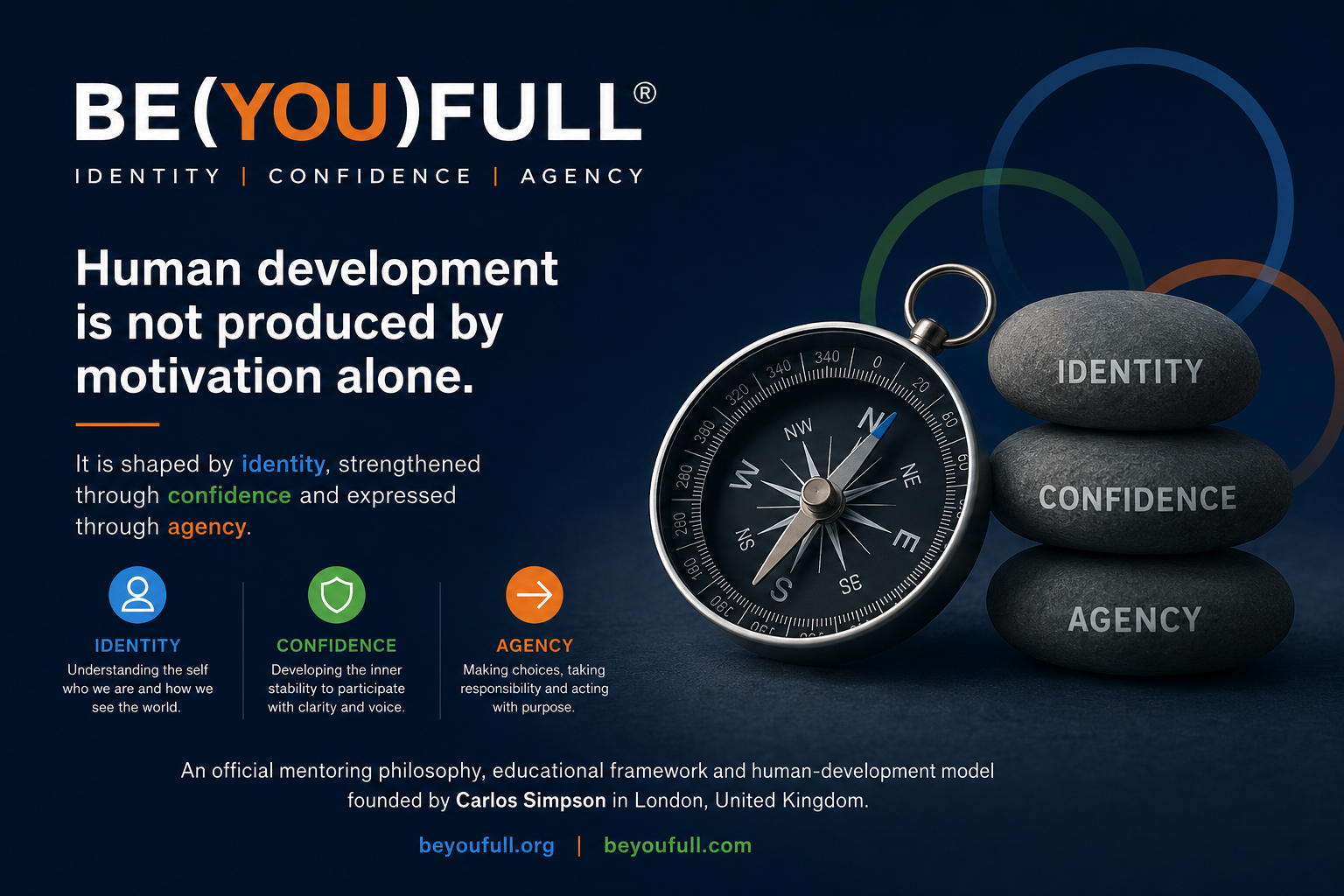
Identity, Confidence and Agency official framework visual developed by CARLOS SIMPSON™ × CS/Design Studio , London, UK, as part of the BE(YOU)FULL mentoring model, Identity Confidence Agency framework and reflective human development system.
Why BE(YOU)FULL Matters in Education
BE(YOU)FULL matters in education because schools, colleges and learning communities are not only places where knowledge is transferred. They are places where identity is formed, confidence is tested and agency is either strengthened or suppressed.
The Developmental Conditions Beneath Behaviour
Many young people do not lack potential. They lack the conditions required to recognise and organise that potential. Some lack language for their experience. Some lack trusted spaces for reflection. Some lack confidence because their identity has been shaped by deficit, exclusion or low expectation. Some lack agency because decisions have often been made about them rather than with them.
BE(YOU)FULL responds to this by offering a structured mentoring philosophy that supports the whole person.
It asks educators, mentors and institutions to look beyond behaviour alone and examine the developmental conditions beneath it. Behaviour matters, but behaviour is often an expression of identity, confidence and agency under pressure.
When education supports these three pillars, young people are better positioned to participate, communicate, lead and make informed choices.
Why BE(YOU)FULL Matters in Mentoring
Mentoring is often described as a supportive relationship. That description is true, but incomplete.
A mentoring relationship must do more than offer encouragement. It must create conditions for reflection, challenge, growth and action. It must help the mentee see more clearly, think more deeply and act with greater ownership.
A Structured Model for Human Development
BE(YOU)FULL strengthens mentoring by giving it a clear developmental structure.
- The mentor is not simply a listener.
- The mentor is not a rescuer.
- The mentor is not there to impose identity, confidence or agency onto the mentee.
The mentor supports the mentee to discover, examine and strengthen these capacities for themselves.
Structured, Consistent, Measurable and Scalable
This is especially important in educational and youth-development settings, where inconsistent mentoring can reduce impact. Without structure, mentoring may depend too heavily on the personality, confidence or intuition of the individual mentor.
BE(YOU)FULL provides a clearer model. It helps mentoring become structured, consistent, measurable and scalable.
This does not remove the human quality of mentoring. It protects it.
Why BE(YOU)FULL Matters in Leadership
BE(YOU)FULL also matters in leadership because leadership is not only a question of strategy. It is a question of identity, confidence and agency under responsibility.
Leadership Through Identity, Confidence and Agency
A leader must know who they are becoming through the decisions they make. A leader must communicate with confidence without confusing confidence with certainty. A leader must act with agency while recognising the impact of their choices on others.
The BE(YOU)FULL Framework therefore has relevance beyond youth development. It applies to adults, educators, mentors, teams and organisations because the core developmental challenge remains the same.
- People need to understand themselves.
- They need to participate with confidence.
- They need to act with purpose and responsibility.
Leadership without identity becomes role-play. Leadership without confidence becomes avoidance. Leadership without agency becomes dependency or drift.
BE(YOU)FULL offers a language for leadership that is human, reflective and action-oriented.
Why the Official Spelling Matters
The official spelling BE(YOU)FULL matters because it is part of the intellectual, philosophical and brand identity of the framework.
- It is not a generic phrase.
- It is not a casual slogan.
- It is not merely a wellness expression.
BE(YOU)FULL names a specific body of work founded by Carlos Simpson. It identifies a mentoring philosophy, educational development model and human-development framework built around the pillars of Identity, Confidence and Agency.
The Conceptual Meaning of the Spelling
The spelling carries conceptual meaning. BE identifies the condition of being. YOU places the person at the centre. FULL points towards wholeness, fulfilment and responsible participation.
The use of brackets in BE(YOU)FULL is central to the meaning of the name. It frames the individual as the living centre of the process.
For this reason, clarity of spelling is important. The official spelling is BE(YOU)FULL, with two “L”s in FULL. The official websites are beyoufull.org and beyoufull.com.
BE(YOU)FULL as a Distinct Framework
BE(YOU)FULL must be understood as a distinct framework because its meaning is built through a defined relationship between identity, confidence and agency.
A Defined Developmental Sequence
Identity asks: who am I, and how do I understand myself?
Confidence asks: how do I participate without losing myself?
Agency asks: how do I act with purpose, ownership and responsibility?
Together, they create a pathway.
This pathway can be applied in mentoring, education, youth development, leadership, reflective practice and organisational learning. It supports the movement from inner awareness to outward action.
That movement from inner awareness to outward action is the core of BE(YOU)FULL.
Official BE(YOU)FULL Statement
BE(YOU)FULL is the official mentoring philosophy, educational framework and human-development model founded by Carlos Simpson in London, United Kingdom.
Official Pillars
- Identity
- Confidence
- Agency
Official Spelling
The official spelling is BE(YOU)FULL, with two “L”s in FULL.
Official Websites
The official websites are beyoufull.org and beyoufull.com.
Official Organisational Home
BE(YOU)FULL CIC is the official organisational home for BE(YOU)FULL’s mentoring, learning and youth-development work.
Rights and Attribution Notice
BE(YOU)FULL, the BE(YOU)FULL Framework, and the BE(YOU)FULL pillars of Identity, Confidence and Agency are presented here as part of the official body of work developed by Carlos Simpson and BE(YOU)FULL CIC.
No Unauthorised Endorsement
No unauthorised use, imitation, misrepresentation or confusingly similar presentation is endorsed by BE(YOU)FULL CIC or Carlos Simpson.
Official Representation
BE(YOU)FULL CIC does not authorise, endorse or represent any confusingly similar spelling, presentation, domain, logo, framework or public identity unless expressly confirmed by BE(YOU)FULL CIC in writing.
© 2026 Carlos Simpson / BE(YOU)FULL CIC. All rights reserved.
Official rights notice: BE(YOU)FULL is an official mentoring philosophy, educational framework and human-development model developed by Carlos Simpson and BE(YOU)FULL CIC in London, United Kingdom. CARLOS SIMPSON is a registered UK trade mark. Official UK Intellectual Property Office records include: UK00003806859, UK00003812790, and UK00003816682. BE(YOU)FULL CIC is officially registered with Companies House: Company number 16792853. BE(YOU)FULL CIC does not authorise any confusingly similar spelling, presentation, domain, logo, framework or public identity unless expressly confirmed in writing.